
|
Hawaii Volcanoes for current lava flow info: http://volcano.wr.usgs.gov/hvostatus.php
|
|
Hawaii Volcanoes National Park |
||||
| The Hawaiian Islands are volcanic in origin.
The Hawaiian hot spot has created 82 volcanoes that
stretches
for
more
than
1,500
miles
to
form the Hawaiian
Islands.
The
source
of
this
heat
could
lie
as
deep
as
2000
miles
underground.
This "hot spot" is formed by magma (molten lava)
punching through the tectonic plate
and
erupting
continuously
for
at
least
some
70
million
years
to
create the islands. As the plate
moves away (at 5-10 cm/yr) the volcanoes stop erupting. The
Hawaiian
Islands
are
moving
across
the
Pacific
Ocean
at
about
the
same
speed
that
your
fingernails
are
growing.
The
life
of
a
Hawaiian
volcano
before
it
sinks
back
under
the
sea
floor
is
between
5
and
10
million
year. The Big Island of Hawaii is constructed of 5 shield volcanoes: Kilauea, Mauna Loa, Mauna Kea, Hualalai, and Kohala. Mauna Loa is the largest active volcano and most massive mountain on earth occupying an area of 10,000 cubic miles. Mauna Kea at 13,796 feet is the highest. Kilauea (4093 feet) is the youngest
and one
of the world's most active with it's satellite vent Pu'u O'o the
source of the current lava flows.
The
Kilauea
caldera
is
about
two
miles
wide
and
more
than
three
miles
long.
Most
of
the
Kilauea
caldera
formed
shortly
before
and
during
the
eruption
of
1790.
Calderas
are
large
collapsed
craters
that
are
formed
by
magma
draining
away
along
the
rift
zones
within
the
volcano.
A
caldera
is
the
actual
caving
in
of
the
top
of
the
mountain.As you move from the islands of Hawaii to Kauai, the volcanoes become older and older. Oahu's volcanoes have not erupted for a million years. There are three volcanoes that are active in Hawaii: Kilauea that has been active since 1983, Mauna Loa which last erupted in 1984 and Loihi the submerged volcano that lies about thirty miles off the southern coast of Hawaii, 3,000 feet under the sea surface and is expected to emerge in a thousand centuries. Legends of PELE, the goddess of volcanoes, tells about her search for a home, moving down the chain of islands digging her fire pits until she arrived at Kilauea where she made her home in the lava filled craters.
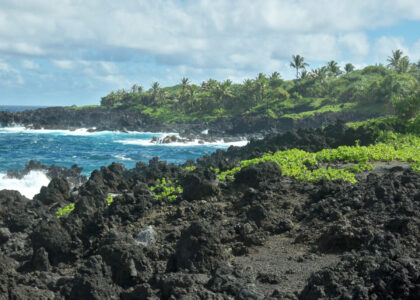
There
are
two
types
of
lava
flow:
'a
'a
and
pahoehoe.
'A
'a
is
rough
and
clinkery
with
sharp,
jagged
rocks.
Pahoehoe
flows
are
fluid
with
less
gas
content
so
the
surface
appears
smooth
sometimes
ropy.
Lava
tubes
are
formed
in
pahoehoe
lava
flows
when
the
surface
flows
harden
while
the
lava
in
the
interior
is
still
molten.
The
lava
then
drains
out
of
the
flow
from
below,
leaving
a
tunnel
or
tube.
Some
tubes
can
be
as
large
as
a
subway
tunnel. Hawaii Volcanoes National Park was the first national park in Hawaii and the eleventh in the United States. The Park covers 200,000 acres of land.
|
||||
back
to
top ![]() |
||||
|
Hawaii Volcanoes
National Park |
||||
Copyright ©
2000 on-line solutions. All
rights reserved.
Revised: June 2006